Saturday, January 16, 2010

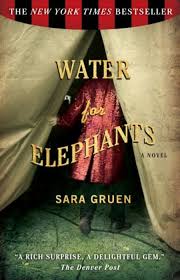
Erin's Book #3: Water for Elephants by Sara Gruen

I have a confession to make. I completely and totally judge books based on their cover. Not just judge, but select. I do at least double check the rating on Amazon, but as long as it's at least a 3.5 of 4, I will read it if I like the cover. I don't always even read the summary to know what it's about it.

So I bought Water for Elephants, having no clue what it was about. Blythe mentioned to me that it was very well-researched, which actually made me less enthused to read it. But I'm really glad that I did.

Water for Elephants follows a traveling, Ringling-wannabe circus around America. The main character is Jacob Jankowski, a veterinary school dropout who ends up aboard the circus train. Occasionally, the book switches to Jacob in present-day, as a 90 (or 93, he can't remember) year old man in a nursing home. While the present day material served to ground some of the more bizarre occurrences of the circus world, for me it most often detracted from the story and I was irritated to have to spend time away from the fascinating circus.

Jacob quickly falls in love with the beautiful Marlena, a performer in the circus who is married to the alternately charming and evil equestrian leader. Their story is compelling, but the real magic of the book lies in the circus itself. Elephants is incredibly well-researched (and includes photos from circuses in their heyday), with many of the plot points based on actual events. I've never really cared for circuses and didn't think I was particularly interested in them, but this book revealed an engrossing and fascinating world. The filth, the animals, the acts, the class system between performers and workers, all of it is told in rich detail to make for a completely riveting read.

I couldn't put this book down; I was addicted to it. I read it in 3 days, the last half in one sitting. It's a beautiful tale of a strange world.

Tuesday, January 12, 2010

Pam's Book 3: The Children's Book


My first A.S. Byatt book was, of course, Possession. I was going to Europe for three weeks and needed one book that was long enough and dense enough to keep me going for nearly three weeks. I came across it in the library, but ended up deciding that a paperback was the way to go. I found the book fascinating, was caught up in the romance and the mystery. The next summer, when I returned to Europe, I decided to make a tradition out of reading Byatt and purchased The Virgin in the Garden for the occasion. The only mystery in that book was why I continued to read it. Every day my fellow traveler Felicia would ask, "Have you figured out what it's about yet?" Finally, on the plane ride home, somewhere over the Atlantic Ocean, I shook her awake. "Felicia, I finished the book." "Have you figured out what it's about yet?" "No."

The Children's Book, on an enjoyment level, fell somewhere between the other two. I feel that at 675 densely packed pages, it was a tad bit long. The story begins in Victorian England like many a good Victorian story: with two boys discovering a third, a talented yet penniless runaway hiding in the basement of what would later become the Victoria and Albert Museum. The runaway, Philip, is of course taken under the wing of the mother of one of his rescuers. He is a skilled artist and wants nothing more than to make beautiful pots. Later Philip is taken in by a temperamental master potter. Yet the story isn't really about Philip, although he makes regular appearances throughout the book, even up to the last page. The story is about Philip and the Fludds (the potter's family), the Wellwoods (two sets), the Cains, the Sterns. The elder family members are ardent political dissidents. One child (of course the unexpected child) follows in their footsteps. While the families are all interconnected (in more ways than we suspect at the beginning), each child, in the end, seems like he should belong to a different family, including the dissident child. Several die in the last fifty pages during World War I.

At first, reflecting on the book, I thought I was disappointed in the lack of strong woman characters. Then I realized that none of the characters was very strongly drawn. This is a book driven by characters, as there is only a faint thread of meandering plot. Yet, very characters seemed very three-dimensional. They all have a wispiness to them. I can't help but wonder, though, whether that might have been intentional. A recurring motif in the book is that of a fairyland, an "other" world, somehow connected to our own and accessed by some kind of magical portal. Characters in fairy tales are most definitely not realistically drawn. Did Byatt have the same idea here? I can't make up my mind.

This is a book of secrets, kept dark in the fairyland, regularly brought out into the light, only to be hidden again and acknowledged later. Some of the secrets are utterly dull and banal; some hold more interest. Sometimes the characters act as expected; some do not. Mothers hide them selves away, whether in stories, drugs, or society. Fathers become alternately sexually abusive and then loving. Or not. Two characters commit suicide. In the exact same way. Which annoyed me.

I think this will be my last A.S. Byatt book.

Sunday, January 10, 2010

DeMerse's Book #1: Geek Love

Geek Love is the story of the Binewski family. Al Binewski inherited his family’s traveling carnival at age 24 and within a few years its popularity began to fade. The idea to save the carnival came to Al while visiting the Rose Garden in Portland, OR. He realized, like the roses in the test garden, that children could be designed. So, he and his wife, Crystal Lil, experimented with illicit and prescription drugs, insecticides, and even radioisotopes during her pregnancies. Papa’s ‘roses’ were Arturo (Arty), who had flippers for hands and feet; Electra (Elly) and Iphigenia (Iphy), the Siamese twins; Olympia (Oly), the albino hunchback dwarf; and Fortunato (Chick), the telekinetic baby with no physical deformities.

Oly is the narrator of the novel and the majority of the story is set during her childhood. It describes her familial relationships as well as those between the Binewskis and the ‘norms’. When Oly asks Arty if reading scared him he replied “These are written by norms to scare norms. And do you know what the monsters and demons and rancid spirits are? Us, that’s what. You and me. We are the things that come to the norms in nightmares. The thing that lurks in the bell tower and bites out the throats of the choirboys—that’s you. And the thing in the closet that makes the babies scream in the dark before it sucks their last breath—that’s me.” Although Oly narrates the story I would argue that Arty is the main character. Over time he takes control of the carnival and manages to manipulate just about everyone he comes in contact with. Even those who see his dark side are still enamored and loyal. This explains how he ends up starting his own cult.

The rest of the story occurs in Oly’s mid to late 30’s. She lives in the same building as her mother and daughter yet neither know that she is anything more than a neighbor - Crystal Lil because she’s lost her mind and Miranda because she was raised by nuns and never knew who her birth mother was. I liked these later years but didn’t like the fact that they were interspersed throughout the novel…I’m not a big fan of hopping back and forth unless it adds to the overall story and I don’t feel that this did.

Geek Love took me longer to read due to my frequent closing of the book and cringing, but I was compelled to continue - with the amputations, murder, topless dancing, and lobotomies - I wanted to know what was going to happen next! Unfortunately I was a bit disappointed in both the ending of the carnival and the book’s ending. When the carnival closed Oly was forced into a world of houses without wheels and explanations. Her answer to the what-the-hell-happened-to-you-looks was "My father and mother designed me this way" and she was proud if it. All of the 'freaks' were proud to be original instead of normal but never really seemed happy. None of them had normal romantic relationships. Iphy explained that "it's OK for me to love a norm like that. But if he comes to loving me it's because I've twisted him and changed him. If he loves me he's corrupted. I can't love him anymore."

Geek Love was both engaging and deeply disturbing. It had me disgusted, envious, frustrated, and sad all at the same time. I just finished last night and I'm still not sure if I feel relieved that it's over or bereaved.

Friday, January 8, 2010

Blythe's Book 6: What I Talk About When I Talk About Running


What I Talk About When I Talk About Running seems like the type of title that suggests there may be an inside joke or a deeper meaning hidden within the novel. However, if you read this book, you will not eventually reach an "Aha! That's how the title fits in!" kind of moment. It really and truly is a book about running. Haruki Murakami is a world famous author (I'm not exaggerating) who typically writes quirky, intellectual novels. Here he takes a break from novel writing, however, to share his thoughts on long-distance running, which he has been engaging in for twenty-odd years. His topics on running run from why he does it and what the process entails to how this makes him a better writer.

So, by now, most people who know me (well or even slightly) will be wondering WHY on earth I, of all people, chose to read this book. I have never been a runner or even athletic. However, my friend and fellow blogger, Pam, and I have been on a long and somewhat sporadic mission to "get in shape" (only offput by my frequent binges into Chinese food and Q'doba and my inherently slovenly nature). Trying to become runners has been an integral part of our regime. I use the term "runners" loosely-- at best, we are joggers; at worst, the term "plodders" comes to mind, in my case especially. When Pam saw this book on a website, she knew it would be a good Christmas present, as it involved two of our common interests: Murakami and running.

So here I am, I've read a book about runnning, and actually enjoyed it. Stranger things have NOT happened. Turns out that what I like best about Murakami's nonfiction is also what I like best about his novels. He writes like someone who has just entered a new world and is blinking, slowly taking it all in, amazed and a bit overwhelmed. There's this certain formality and self-effacement he possesses that I have come to link with the Japanese in general. I went to Japan this past summer and found the people to be the most humble and modest I've ever met. Murakami is much like this; he is always downplaying his successes and accepting rudeness in others. For instance, when he is repeatedly kicked, intentionally, before a triathlon, he says this must be expected. No anger or resentment; just acceptance. When he accomplishes just about anything, he feels relief or appreciation-- never self-pride.

What I came to learn about Murakami through his memoir is that he is a workhorse, obsessed with whatever he takes on, singular in purpose, and extremely gracious towards others. Aboce all else, he seems to value focus, patience, and endurance. He is first a bar owner, then a novelist, then a long-distance runner, then a translator and lecturer and a triathlete. He never starts with a coach or a class, instead preferring to do something on his own first, learning by trial through fire, and continuing simply because he has decided to.

If you've never read Murakami, but are interested in giving him a try, I wouldn't necessarily recommend this to start out with (unless it is the topic, not the writer, that you are interested in). His most popular works are probably Kafka on the Shore, Norwegian Wood, and The Wind-up Bird Chronicle-- all good samples of his work.

I've decided to share some favorite tidbits:
- On why it's better not to be stick-thin (which could suggest healthiness even if the person is not): "Some of my readers may be the kind of people who easily gain weight, but the only way to understand what's really fair is to take a long-range view of things. . . I think this physical nuisance [being heavy] should be viewed in a positive way, as a blessing. We should consider ourselves lucky that the red light is so clearly visible" (42).

- After finishing his first marathon: "I sit at a cafe in the village and gulp down cold Amstel beer. It tastes fantastic, but not nearly as great as the beer I'd been imagining as I ran. Nothing in the real world is as beautiful as the illusions of a person about to lose consciousness" (66).

- On follow-through: "If I used being busy as an excuse not to run, I'd never run again. I have only a few reasons to keep on running, and a truckload of them to quit. All I can do is keep those few reasons nicely polished" (73).


I almost feel like lacing up and going out for a jog-- and there are few books that can inspire such a reaction in this gal.
Erin's Book #2: The Middle Place by Kelly Corrigan

Trying to select my second book to read, I laid out a stack of contenders and asked my boyfriend for help. He suggested I select the one that would be the most uplifting and inspiring to help get the new year off to a good start. I chose a memoir about cancer, which may seem like an odd choice, but hey, there's a small girl in a yellow dress jumping on the cover!

I think it was the perfect choice. I. Loved. This. Book. Kelly Corrigan takes us through her journey with breast cancer, beginning with discovering a lump while bathing with her two young daughters. She also interweaves stories of growing up amongst her big, devoted family, from her earliest memories to meeting her husband.

Although death weighs heavily over the entire book, The Middle Place is an uplifting, emotional story. The title refers to the place between childhood and parenthood, being both a mother and a daughter, and the inevitable growing up. This book is ultimately about the people in our lives that make our lives what they are. I wanted to be a Corrigan, but this book also made me so grateful for my own family and friends. I laughed, I cried, I wanted to call my parents and hug my boyfriend repeatedly.

Corrigan's writing is vivid, beautiful, and honest, whether she's describing a high school fight with her mom over a pair of Guess jeans or shaving her head to protect her daughters from watching her slowly lose her hair. Obviously, stories like this make you grateful for your health, but they also help you appreciate the small things in life that make it worth living, the little moments with the people you love.

Wednesday, January 6, 2010

Blythe's Book 5: Lime Tree Can't Bear Orange


Lime Tree Can't Bear Orange (from here on referred to as LTCBO) is the story of Celia D'abadie, a Tobagan (is that even a word??) raised by her kind but naive aunt. Celia leaves Tobago for Trinidad after being raped, and there finds herself employed by the kind Dr. Emanuel Rodriguez, who later seduces her. It may feel like I'm giving away too much of the plot, but very little comes in this novel that you couldn't predict as soon as a character is introduced. You know Celia's uncle is no good; you know Dr. Rodriguez will eventually seduce her; you know the lovestruck gardener, William, will never be enough for our complicated heroine.

At first this bothered me-- the prose is beautiful, as are the descriptions of the lush (and at this time highly coveted as I'm freezing my wimpy Floridian ass off) tropics of Trinidad and Tobago-- but the story is just so danged predictable. However,after finishing the novel I was hit with a revelation. Amanda Smyth, the author of LTCBO, repeatedly stresses throughout the novel that we don't determine our own life, we simply follow the path that has been laid before us. Celia is told almost this exact thing by one of the secondary characters, Joseph Carr Brown: "I believe you follow your life, Celia. You don't lead your life. It's a mistake people make. We're not that powerful or important" (99). Even earlier in the novel, Celia runs across a soothsayer, Mrs. Jeremiah, who tells her that the path she will follow is a predetermined and hard one. This is not a prediction in Celia's eyes-- as it comes from the mouth of Mrs. Jeremiah, it is taken as truth. Smyth seemed to incorporate this same belief in her writing; the path laid before us, as readers, is clear. There are few surprises for us to stumble across in LTCBO. However, the story is still extremely interesting, reminiscent of Edwidge Danticat's work both in its style and subject, and I was compelled to finish it. (And this is saying a lot, considering for every book I finish there are probably two or three I toss aside halfway through.) Smyth suggests that the story she is about to tell is already laid forth; she cannot change it or stray from the path before her. No suprises, just life in all its complicated, messy, heartwrenching glory. Lucky for me, this didn't make it a less worthwhile read.

Sunday, January 3, 2010

Blythe's Book 4: Half Broke Horses by Jeannette Walls


The last three weeks have been my idea of heaven on Earth: I've read four books, tried at least three new recipes, slept in often, tried several new beers, and spent much time with family and friends. Ah, the holidays.

There were four books in particular that I had been eagerly awaiting, and this, my friends, is the fourth and final one: Half Broke Horses by Jeannette Walls. I wish I had finished with The Lacuna, seeing as I absolutely loved it, or even This is Where I Leave You, which had me laughing nonstop. Half Broke Horses was decent, but it didn't live up to the hype. The hype was self-created, so it was my own fault, but still.

Jeannette Walls' earlier memoir, The Glass Castle, still haunts me. I loved that book so much that I was beside myself when I heard she's written HBH, a "true life" novel. What is a true life novel, you ask? Basically, she takes the stories and remembrances of her mother and her family members and weaves them into a cohesive story-- adding in dialogue and details as needed, I'm assuming. HBH is the story of Jeannette's maternal grandmother, Lily Casey (Smith). Lily is a hardworking, tough as nails character-- a horsewoman, school teacher, taxi driver, mother, and pilot. She lives most of her life on ranches out West, and it is fascinating learning about how life was in the early 1900s in cattle country. If you've read The Glass Castle, you'll also find Half Broke Horses informative as a background story. Jeannette's mother, Rosemary, is one of the most memorable characters I've ever encountered, so coming to understanding from whence she came was motivation for reading this novel. I feel like I understand her much better now. UNFORTUNATELY, I just didn't like the novel that much. Walls' writing was really boring. Repetitive, uninspired, dull. I think she was trying to capture Lily's voice, but truth is, I want authors to write well. I don't go to restauarants so I can eat what I make at home, and I don't read books that are written the way anyone could write them. Walls uses the phrase "crumb-bum husband" at least five times. Who says that?! It was kind of like reading a Patrick Smith novel, for those of you who've read A Land Remembered, or any of his other works. You don't read a Smith novel because the language is beautiful, or because he knows how to turn a phrase; you read Smith's work because the storyline is compelling. If you choose to read Walls' Half Broke Horses, go in with the same mindset. You'll thank me.

Anyway, I think I might just try to cram one more book in this coming week so I can head back to the grind with memories of something a bit more tasty.